


Cámaras Flock en Houston
Learn how Flock automated license-plate readers (ALPRs) in Houston and Harris County raise critical Fourth Amendment, Texas constitutional, and federal immigration data-sharing concerns.
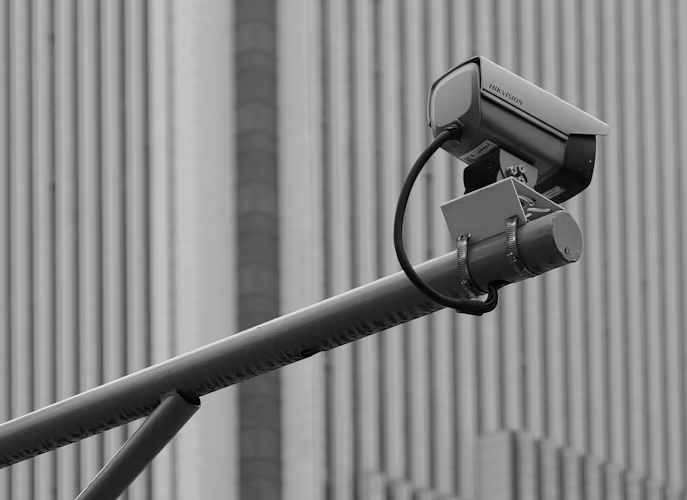
A Flock camera may capture only a split-second image of a vehicle on a public road. But a network of those cameras can retain location records, connect them to identifying vehicle characteristics, and make them searchable long after a person has driven away.
That distinction is at the center of the growing legal fight over automated license-plate readers, or ALPRs, in Houston, Harris County, and across the country.
The central constitutional question is not whether police can see a license plate in public. They usually can. The harder question is whether government agencies may build and search a historical, interconnected record of where people have traveled—especially when that record can be shared across jurisdictions or used in support of federal immigration enforcement.
The legal line is increasingly about scale: isolated public observations are generally lawful; a system capable of reconstructing the whole of a person’s movements may be different.
The Federal Constitution: Public Observation Versus Mass Tracking
The Fourth Amendment prohibits unreasonable searches and seizures. Under traditional doctrine, a person has little or no reasonable expectation of privacy in a license plate or the visible exterior of a car traveling on public roads.
That principle explains why courts have generally rejected challenges to a single plate read, a limited ALPR query, or a small number of Flock images. In United States v. Martin, a federal court held that officers’ review of a Flock database was not a search on a record showing only three relevant photographs over 30 days. In United States v. Jackson, another court rejected a Fourth Amendment challenge after officers used Flock alerts and obtained nine vehicle-location points in a single day.
But that is not the end of the constitutional analysis. In Carpenter v. United States, the Supreme Court held that police acquisition of historical cell-site location information was a Fourth Amendment search because it created a detailed, retrospective chronicle of a person’s movements. The Court focused on data’s depth, breadth, automatic collection, retrospective availability, and power to expose intimate associations and habits.
Flock litigation is testing how far Carpenter extends. Challengers argue that a dense ALPR network can create a comparable location archive: police do not have to identify someone in advance, because a searchable system has already preserved their vehicle’s movements. Governments respond that fixed cameras do not follow a person everywhere, do not record every trip, and only capture a vehicle at particular public locations.
The result is a fact-dependent constitutional inquiry. The more a network operates like a series of limited checkpoints, the stronger the government’s position. The more it operates like a searchable, regional movement-history system, the stronger the Carpenter argument.
The Texas Constitution: An Independent Argument Still Waiting for a Test Case
Texas Constitution Article I, § 9 provides its own protection against unreasonable searches and seizures. Texas courts are not required to interpret that provision in lockstep with the federal Fourth Amendment. In Heitman v. State, the Texas Court of Criminal Appeals held that Texas courts may independently interpret Article I, § 9 and may provide protections beyond the federal constitutional floor.
That matters because no reported Texas appellate decision has squarely decided whether a Flock or other ALPR network is a search under Article I, § 9. A Texas challenge therefore should not merely repeat a federal Carpenter argument. It should separately address Texas constitutional text, privacy and liberty interests, the actual scope of data collection, and the specific safeguards—or lack of safeguards—governing the network.
For criminal defendants, Texas Code of Criminal Procedure article 38.23 generally excludes evidence obtained in violation of the Texas or federal Constitution or laws. The practical obstacle remains proving that the particular Flock collection or query was a constitutional search and that the challenged evidence resulted from it.
The Leading Court Fight: Schmidt v. City of Norfolk
The leading Flock constitutional case is currently outside Texas. In Schmidt v. City of Norfolk, plaintiffs challenged Norfolk, Virginia’s Flock system under the Fourth Amendment.
At the pleading stage, the court allowed the lawsuit to proceed. The complaint plausibly alleged that a dense network of cameras, a searchable vehicle database, and retained data could create dragnet-style surveillance (Schmidt v. City of Norfolk (E.D. Va. Feb. 5, 2025)).
After discovery, however, the same court granted summary judgment for Norfolk. The record showed 176 cameras grouped in 75 locations, a 21-day rolling retention period, and an average of roughly two to three full-plate captures per day for the plaintiffs. The court concluded that this system did not reveal the whole of a person’s movements in the way that historical cell-site data or citywide aerial surveillance could (Schmidt v. City of Norfolk (E.D. Va. Jan. 27, 2026)).
The case is on appeal in the Fourth Circuit, No. 26-1227. As of August 3, 2026, I could verify appellate briefing activity and amicus participation, but not a merits ruling from the Fourth Circuit (Fourth Circuit docket).
The lesson for Texas is straightforward: a constitutional claim will likely rise or fall on the facts. Courts will want to see the effective camera map, how often a person’s car is captured, data-retention practices, how far the search network reaches, what queries can be run, and whether the system can actually reconstruct daily patterns rather than merely identify scattered locations.
Houston and Harris County: The Current Fight Is Mostly About Oversight
In the Houston area, the public fight is presently centered more on contracts, oversight, public records, and alleged misuse than on a mature constitutional lawsuit.
Harris County materials identify a memorandum of understanding involving Flock Group, Inc. d/b/a Flock Safety and access for the Fire Marshal’s Office to FlockOS and images or associated information from Flock devices for law-enforcement purposes (Harris County agenda item 26-0656).
Houston City Council’s Public Safety Committee has also considered a “Flock Safety Review and Partnership,” reflecting continuing local scrutiny (Houston Public Safety Committee materials).
Nearby controversies show why controls matter. Baytown police announced an internal-affairs and criminal investigation in July 2026 following an allegation that an officer misused the department’s Flock system (Baytown investigation report). In Conroe, reporting indicated that the Texas Attorney General required release of certain Flock-related information following an open-records dispute (Houston Chronicle report).
As of August 3, 2026, no reported Houston or Harris County decision has squarely enjoined Flock cameras on federal or Texas constitutional grounds, or suppressed evidence because of Flock use.
The Immigration-Enforcement Concern: A Local Camera Network Can Become a Federal Enforcement Tool
The immigration issue is not that every Flock image automatically goes to Immigration and Customs Enforcement or Customs and Border Protection. Flock says it has no direct ICE contract, that federal-agency sharing is default-off, and that local customers control whether data is shared. Flock also says it ended federal pilot projects in August 2025 after operating a CBP pilot from May through August 2025 (Flock’s public statement on ICE and CBP access).
But the practical civil-rights concern is broader: a local agency may be able to facilitate federal immigration enforcement by choosing to share data, respond to a federal request, or use a local Flock search to locate a vehicle. The legal and policy safeguards that constrain those choices vary by jurisdiction.
There is documented evidence from other states that this concern is not theoretical:
- Illinois’s Secretary of State concluded that Flock allowed CBP access to Illinois ALPR data in violation of state law and ordered that access shut off (Illinois Secretary of State audit announcement).
- California reporting based on agency records found local agencies conducting ALPR searches for ICE and CBP, despite California restrictions on federal and out-of-state ALPR sharing (CalMatters investigation).
- The Electronic Frontier Foundation’s Marin County litigation describes records showing local ALPR information shared with ICE, CBP, and many other agencies (Lagleva v. Marin County Sheriff).
Texas has a different legal and policy landscape. I did not locate a Texas statute comparable to California’s or Illinois’s ALPR-specific restrictions on sharing data with federal immigration agencies. That absence does not itself authorize every form of sharing; agency policy, contract terms, public-records law, constitutional limits, and the facts of a particular request still matter. But it places heightened importance on local guardrails.
The concern has special force in Houston. Texas Tribune reporting in July 2026 described increased ICE street arrests in Texas and reported that Houston police had worked with ICE 103 times since April, with immigration warrants in the National Crime Information Center playing a role in local–federal cooperation (Texas Tribune reporting on Houston police and ICE cooperation). That reporting does not establish that Flock data was used in those encounters. It does demonstrate why the access rules governing local surveillance systems deserve close public scrutiny.
Why Flock Access Can Matter to Immigrants and Mixed-Status Families
A searchable plate-reader network can potentially reveal a car’s location and travel patterns without an immigration agent conducting physical surveillance. If local officials run a query, honor a federal request, or enable reciprocal access, ALPR data can help locate a person who has not been accused of a crime. The resulting risks include:
- location-based enforcement against people driving to work, school, medical appointments, houses of worship, or family gatherings;
- heightened surveillance of mixed-status families, where one person’s vehicle use may expose others to enforcement attention;
- pressure on witnesses and crime victims who may become less willing to report crimes or cooperate with local police; and
- chilling effects on protest activity, religious association, legal services, and ordinary community participation.
Estas preocupaciones no constituyen automáticamente una violación de la Cuarta Enmienda. La doctrina actual de la Cuarta Enmienda sigue centrándose en si el alcance de la recopilación y el acceso se convierte en un registro al reconstruir la totalidad de los movimientos de una persona. Sin embargo, los usos relacionados con la inmigración aumentan los riesgos: un sistema justificado inicialmente como una herramienta de seguridad pública puede ser reutilizado para la aplicación de leyes de inmigración civil contra personas que nunca han sido sospechosas de cometer un delito estatal o local.
Teorías constitucionales más allá de la Cuarta Enmienda
El uso relacionado con la inmigración también puede dar lugar a reclamaciones adicionales según los hechos:
- Preocupaciones sobre la libertad de asociación de la Primera Enmienda si la vigilancia o los registros dirigidos obstaculizan la asistencia a protestas, servicios religiosos, reuniones políticas o actividades de apoyo legal.
- Preocupaciones sobre la igualdad de protección si los funcionarios despliegan, consultan o comparten datos deliberadamente basándose en la raza, el origen étnico, el origen nacional u otra clasificación protegida.
- Preocupaciones sobre el debido proceso y los derechos civiles si una agencia local actúa fuera de su autoridad legal, no sigue las políticas adoptadas o utiliza datos por razones personales o discriminatorias prohibidas.
- Cuestiones de derecho estatal y rendición de cuentas pública relativas a contratos, retención de datos, registros de acceso, divulgación y las normas que una agencia ha adoptado para su propio personal.
Cada una de esas teorías depende de la evidencia de una conducta real. La existencia de cámaras Flock por sí sola no prueba intención discriminatoria, coordinación ilegal en materia de inmigración o un registro inconstitucional.
Las preguntas que Houston y el condado de Harris deben responder ahora
Las preguntas más importantes son operativas, no abstractas:
- ¿Quién puede realizar búsquedas en el sistema? ¿Qué entidades del condado, municipales, estatales, federales y privadas pueden acceder a los datos del área de Houston?
- ¿Qué datos están consultando? ¿La búsqueda se limita a las cámaras del gobierno local o incluye las de asociaciones de propietarios, empresas, ciudades vecinas y otros estados?
- ¿Cuál es la norma de retención? ¿Cuándo se eliminan las imágenes y pueden los usuarios descargarlas o conservarlas más allá del período de retención predeterminado?
- ¿Se pueden compartir los datos con el ICE o la CBP? En caso afirmativo, ¿bajo qué política escrita, proceso de aprobación y autoridad legal?
- ¿Qué registros existen? ¿Todas las búsquedas, alertas, descargas, opciones de intercambio y solicitudes federales quedan registradas y son auditables?
- ¿Qué restricciones se aplican? ¿Existen prohibiciones expresas sobre el uso personal, el apoyo a la aplicación de leyes de inmigración, el monitoreo de protestas, la vigilancia de lugares religiosos, la vigilancia de la salud reproductiva o las búsquedas que carecen de un propósito documentado de cumplimiento de la ley?
- ¿Qué sucede tras un uso indebido? ¿Existe una notificación inmediata, una revisión independiente, medidas disciplinarias y un informe público cuando un agente realiza una búsqueda indebida?
La ley de registros públicos de Texas puede ser parte de la lucha por la rendición de cuentas. El Código de Gobierno de Texas § 552.130 protege cierta información de identificación, título y registro emitida por el DMV, pero no clasifica categóricamente como confidencial una matrícula captada en un video policial (Tex. Gov’t Code § 552.130). Es posible que se apliquen otras excepciones, especialmente en investigaciones activas, pero las agencias no deben tratar todos los registros conectados a un sistema de lectura de matrículas como si estuvieran automáticamente fuera del escrutinio público.
Conclusión
Las cámaras de Flock no son inconstitucionales por el simple hecho de leer matrículas en vías públicas. Según las decisiones judiciales vigentes, el gobierno suele ganar cuando los datos consisten en unas pocas imágenes de cámaras fijas durante un período limitado.
Pero la ley sigue evolucionando. El peligro constitucional aumenta cuando muchas cámaras, amplios acuerdos de intercambio de datos, una retención prolongada y la posibilidad de buscar huellas digitales de vehículos crean un registro retrospectivo que permite al gobierno reconstruir los movimientos y asociaciones de una persona. Esa preocupación se vuelve aún más grave cuando las herramientas de vigilancia locales pueden utilizarse, directa o indirectamente, para ayudar a la aplicación de las leyes federales de inmigración.
Para Houston y el condado de Harris, el debate legal y político inmediato debería centrarse en la cobertura, la retención, el intercambio, los controles de consulta, los registros de auditoría y los límites a la aplicación de las leyes de inmigración. Esos detalles determinarán no solo si el sistema cuenta con una rendición de cuentas significativa, sino también si finalmente cruza la línea constitucional trazada por Carpenter.
Nota sobre la fuente
Esta publicación se basa en las decisiones judiciales, los registros gubernamentales y los informes vinculados. El enlace de The Texas Tribune proporcionado para un artículo del 3 de agosto de 2026 no pudo ser recuperado de forma independiente para su verificación durante la preparación, por lo que esta publicación no atribuye afirmaciones fácticas no verificadas a dicho artículo. La fuente verificada de forma independiente más reciente discutida anteriormente es el informe de Baytown del 27 de julio de 2026 sobre un presunto uso indebido del sistema Flock.
Esta publicación proporciona información legal general, no asesoramiento jurídico. El análisis constitucional de cualquier programa específico de ALPR/Flock depende de su despliegue real, sus políticas, su configuración de intercambio de datos y su uso en una investigación concreta.





Póngase en contacto hoy mismo: estamos abiertos las 24 horas, los 365 días del año.
En Salinas Defense, su solicitud de consulta es confidencial y nuestro equipo está aquí para ayudarlo a dar el siguiente paso con claridad y confianza.